Wednesday, May 23, 2018

Epilogue


This is the 10th anniversary of the unveiling of the Battle of Barra memorial and a fitting time to close out this blog.
It was a great deal of fun to produce and I have met many interesting people.
I hope you enjoyed reading it.

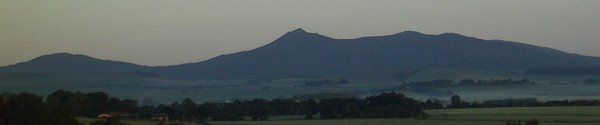
But now as I leave for the last time and glance back at the memorial, is it my imagination, a trick of the light, or did I glimpse the hero king gazing out over the scene of his long-passed triumph.


People to thank


As this blog approaches it’s ends I need to acknowledge the many people who have made it possible.
Firstly, a big thank you goes to the Meldrum and Bourtie Heritage Society (MBHS), who’s work on the Battle of Barra 700th anniversary memorial, forms a large part of this blog.


I would like to especially thank Evelyn Munro, for providing pictures and feedback on the progress of the memorial and coordinating with others to gather information on various subjects.


John Pirie was instrumental is providing information on the original location of Bruce’s seat and locating it in the rock pile where it lay for over half a century. Also, for his work on the memorial.


Doug Smith for his work on the memorial and for providing details of the moving of Sir Thomas and his lady from the kirk yard to its current location in Bourtie Kirk.

Doug Smith with Sir Thomas and his Lady

Rev. Hugh O’ Brien, of Meldrum and Bourtie parish, for taking the time to open the church for me and allowing me to take pictures of Sir Thomas.
Rachel Ann Dressler who provided information on the possible dating of Sir Thomas and his lady.
Bob Forsyth who provide the details of the Battle of Barra float, in the 1954 Meldrum sports.
Moira Gregg for her Scottish Field article on the battle and providing the picture of Wallace’s putting stone.
Rev. Angus H. Haddow for detail of the Grenago Stane from his work,
“Dowsing for Patterns of the Past – The Stone Circles of Aberdeenshire”.
The following for pictures
Anne Burgess – Elgin Castle.
Les Harvey – Bruce Hill
Chris Lodge – Aikey Brae Stone Circle.
Martyn Gorman – Slains Castle
Keith Kaase - Bust of Robert I.

Finally a thank you to my wife Juliet who offered encouragement and support and consented to be dragged around various sites, as I sought information or photographs, when we were supposed to be on vacation.


Juliet and Jim on Bruce's seat.


A Final Summary


The Battle of Barra has tended to be a footnote in history, viewed as one small step on the road to Bannockburn and ultimately independence, but I would contend that is was a pivotal event in achieving Scottish independence.

Prior to the 1307 campaign the Bruce cause was in tatters and no one could realistically expect him to succeed, and although his fortunes improved during 1307, there were still several Scottish enemies who could probably individually destroy his small force.

With victory at Barra, he defeated the strongest of his Scottish enemies and went on to destroy the Comyn powerbase in NE Scotland. Following this success, he went on to destroy or neutralize his Scottish enemies, and within a year no Scottish magnate had the power to resist him without English support.

Shortly after Barra, he captured Aberdeen and its port which offered him access to Europe. It was for several years the only major European trading port held by Bruce. (Dundee 1312; Perth 1312; Leith 1314; Berwick 1318). During these years Aberdeen would operate as a base for commerce raiding (basically piracy) and trade with Europe.

Without the victory at Barra it is unlikely that Aberdeen would have been taken and access to the resources to support the war would have been near impossible to obtain in the quantities required. (For more details see post)


Although there was still a long and dangerous path to Scottish independence, after the victory at Barra things would never  be so perilous as they were in 1306/7.


Barra Today


There is nothing visible today which can be directly linked to the battle, and the actual site is a matter of conjecture, however that does not mean that there is nothing to see.
With that in mind, I would like to highlight seven locations which may be of interest and have featured in the blog.


1:  Bruce’s Field is by tradition the site of the battle, it is located to the left of the main Inverurie to Oldmeldrum road (B1970), when travelling towards Oldmeldrum.

There is little to differentiate is from the adjoining fields and there is nothing to see from the road. It can best be viewed from the top of Barra Hill, which can be reached by the footpath between “Blankets” and Bourtie Kirk. (For precise details see below)
The entrance to the footpath from the Oldmeldrum end.
http://www.geograph.org.uk/photo/797939
Bruce's Field from Barra Hill


2: Barra Hill, is the location of three places of interest, which can be reached by the footpath.
A: The Iron Age hill fort which predates the battle by over a millennium.


Iron Age hill fort and Comyn's Camp

B: Comyn’s camp, which is the same location as the hill fort, is by some traditions where the Earl and his army camped the night before the battle. However, there is no evidence to support these traditions.
C: Wallace’s putting stone, is a large serpentine rock standing on Barra hill, which according to legend was thrown by Wallace from Bennachie, into Comyn’s camp to aid the king’s army.
See post for details:
Wallace's Putting Stone

3: Bourtie Kirk is the location of two stone figures, a knight and a lady, who are associated with the legend of Thomas De Longueville. Legend has it that Sir Thomas a companion of Robert I, was mortally wounded, and in true Robin Hood fashion fired an arrow, to determine where he should be buried.
The Kirk is not open to the public, but there are regular services. (See link below)
For more information see Marion Youngblood’s book “Bourtie Kirk 800 years”

Sir Thomas and his Lady


4: Lawel Hill, features a legend of the battle where Robert I’s army gathered cattle and tied lanterns to their horns and stampeded them at Comyn’s army. (See post for details.)
Lawel hill is located to the south of Barra Hill and can be viewed for the summit.

Lawel Hill from Barra Hill


5: The original site of Bruce’s seat, was just off the old footpath which ran up the eastern slope of Barra Hill. For details of the location and see John Pirie’s account.

The east side of Barra Hill from the golf course


6: The Grenago Stane, is located on the 14th fairway of Oldmeldrum golf course.


This according to legend is where the Earl of Buchan is said to have lamented his defeat. (For details see post)


It can be viewed from Kirk Brae, just take care to avoid flying golf balls.
http://www.geograph.org.uk/photo/898972


The Grenago Stane


7: Battle of Barra Memorial, was unveiled ten years ago, and details of the project are included in numerous posts on this blog. It is located on the north side of the Barra roundabout, on the B9170.

Battle of Barra memorial


The battle field today is described in the “inventory boundary” and “battlefield landscape” sections of the Historic Scotland battlefield inventory.

One last thing, if you are visiting any of the locations, please treat them with respect.


Tuesday, May 22, 2018

The Comyns the final chapter.


As seen in an earlier post the Comyns had prospered in the first three decades of the 13th century and assumed a dominant position in Scottish affairs which would last until their final defeat by Robert at Barra.  http://barra1308.blogspot.com/2012/04/comyns-3.html

In the coming years this dominance would be challenged by rivals, but the Comyn party would work together to thwart the efforts of their various challengers.

When William the Earl of Buchan died in 1233, his son Walter, Earl of Mentieth and Lord of Badenoch, assumed the leadership and confronted the challenge from their north eastern neighbors, the Bissets and the Durwards.

The suspicious death of Patrick of Atholl in 1242, was the opportunity the Comyns needed to attack their Bisset challengers who had been gaining more influence with the King (Alexander II). Walter and John Bisset were implicated in the death and the Comyns, with the support of other nobles achieved the exile of the pair. Fleeing to England the Bissets encouraged the interference of Henry III in the affairs of Scotland, an unfortunate reality accepted by most in Scotland, but which would lead to disaster before the end of the century.

At the close of the reign of Alexander II, the Durwards rose to be the principle advisers to the king, and on his sudden death they retained control during the minority of Alexander III. The Comyns seized the young king and his queen taking control of the government, forcing out the Durwards. The Durwards sought Henry’s assistance, and again all were forced to accept his intervention. (It should be noted that Alexanders queen was Henry’s daughter, and he did have genuine concerns for her safety).

This is the period in which the later chroniclers paint the Comyns as “over mighty subjects”, but they were by then partisan Bruce/Stewart spin-doctors, and sought to unfairly discredit the Comyns.

For the remainder of Alexander III’s reign the Comyns were prominent in the affairs of the realm, and on his untimely death were instrumental in stabilizing the situation and provided two of the Guardians of the realm during the first interregnum. (John II of Badenoch and Alexander Earl of Buchan).

Following the death of Margaret, the heir to the throne, the Comyns supported the Balliol claim, during the period of the “Great Cause”, in which Edward I was asked to adjudicate the claimants to the throne,

However, the Comyns also had a weak claim to the throne through Richard Comyn’s marriage to Hextilda, the daughter of king Donald Ban. John II of Badenoch also had a claim to the throne due to his marriage to Eleanor the sister of John Balliol, but that claim would always be subservient to that of John Balliol and his descendants.

Edward ruled in favor of John Balliol who became King of Scots, but Edward’s heavy-handed approach eventually lead to war.

The Comyns would consistently support the Scottish side during the war and John Comyn III, co-led the Scottish victory at Roslin in 1303, but about a year later the Comyns and the other Scottish magnates submitted to Edward, and it appeared the war was finally over.

But, two years later Robert the Bruce, murdered John Comyn, in Greyfriars church, the pivotal event that led to Scottish independence and consigned the Comyns to the historical dustbin.

Robert after numerous setbacks, eventually crushed the Earl of Buchan at Barra, and went on to totally destroy Comyn power.

It is somewhat ironic that the Comyn family rose to power by crushing two campaigns, launched from Moray, to seize the Scottish throne, but were themselves destroyed by a third. Also, that the last senior male heir of the family, (John IV) who had for a century defended the Scottish crown should be killed fighting on the English side at Bannockburn.

Thursday, May 3, 2018

10 years on


It has been a long time since I posted, but with the 10th anniversary of the unveiling of the Battle of Barra Memorial is coming up, I have decided to close-out the blog and commemorate the anniversary.
Between now and the 23rd of May, I plan to clean-up the blog, and make around half a dozen new posts, with the final one on the 23rd May.

Wednesday, April 10, 2013

Historic Scotland’s – Inventory of Historic Battlefields

Bruce's Field viewed from Barra Hill


Historic Scotland has identified the Battle of Barra as worthy of inclusion in their list of battlefield sites, considered to be of national importance.
Follow this link for detailed information on process and the purpose of the current inventory.


The consultation and report on the Battle of Barra have been completed,

and details can be found, at the following link:
The report gives an outline of the battle and related history, as well as maps showing the boundaries of the site, suggested deployment of the opposing armies, and the location of points of interest.
The aim of the reports is to raise awareness of these important sites, so please visit the Historic Scotland site.


Wednesday, April 25, 2012

The Comyns 3

Following the successful suppression of the 1211 MacWilliam rebellion, the Comyns continued to expand their influence and land holdings. William Earl of Buchan, played an increasingly important part on the national scene, 
witnessing charters from places as widespread as the north of England, and Fyvie, in his own heartland. He also played a key role in the coronation of Alexander II at Scone, in 1214 following the death of his father.  Although the Comyns held lands throughout Scotland and England, William began to consolidate their power in the North East, and under his patronage Deer Abbey was founded in 1219.


The Abbey of Deer *

This consolidation an expansion continued in a relatively peaceful fashion until 1229 when another MacWilliam rebellion erupted out of Moray.
Alexander II, having failed to suppress the rebellion in person, again appointed William, the Warden of Moray, with the authority and resources to “get the job done”. The Comyns duly complied, and the heads of Gulleasbuig and his sons were delivered to the King, who in gratitude conferred the Lordship of Badenoch on William’s son Walter.  The royal “enforcers” now directly controlled a swath of land across the breadth of northern Scotland, in the shape of the Lordships of Lochaber, Badenoch, and the Earldom of Buchan. This effectively stabilized the north for the crown and ended the MacWilliam threat for good.
So as another generation prepared to “assume the mantel”, they had the benefit of the huge support structure, created by Richard and William, based on, landholding, ties of marriage, and a large following of allied families, all of which made-up the formidable Comyn Party. 

Source: Alan Young (The Comyns)

But things would not always go smoothly, because there were other “new men”, who also wanted a share of the Scottish pie. 

* For exact location of Deer Abbey follow this Geograph link:
http://www.geograph.org.uk/photo/2917066

Friday, April 20, 2012

Sir Thomas – The Final Word

Having devoted so much blog time to the good Sir Thomas, I was thinking, “enough is enough”, he does after all appear to be no more than a colourful local legend. But! - Although I would probably never know whom, the effigies represented, I was still intrigued as to their date. During my research I came across an excellent book by Rachel Ann Dressler, called, “Of Armor and Men in Medieval England”, in which she studies three specific early 14c English knight effigies.
Rachel is Associate Professor of Art History at the University of Albany, NY.
I decided to ask if she would give an opinion on the figures, and e-mailed her a link to the blog and some pictures, which she was kind enough to review and her reply is below.

Dear Jim,
Having looked at the photo, I would venture that the effigies date certainly after mid-13c but before 1315. Since the figures are abraded it is a little difficult to tell, but my inclination is early fourteenth century. I hope this helps.
Best,
Rachel
So, it appears that the figures are close in time to the battle, and certainly concurrent with the period of sporadic internecine warfare from Alexander’s death until the Scottish victory at Bannockburn. Of coarse this did not end the violence, but it was more focused in the border regions after 1314.
We now have the tantalizing possibility that the effigy really does represents one of the fallen of Barra, but, could just as easily represent a minor noble who died in his bed. One of the points to emerge from Dressler’s book is that the martial splendor of the effigy did not always accurately reflect the life of the man it commemorated. They were often in fact no more than “sculptural spin”.
The last paragraph on the dust cover explains:
“Ultimately, Dressler’s analysis of English knight effigies demonstrates that the masculine warrior during the late Middle Ages was frequently a constructed ideal rather than a lived experience.”
With that said I think it is time to finally lay Sir Thomas to rest.


RIP - Sir Thomas and Lady de Longueville


Sunday, September 11, 2011

Battle of Barra Blog Wordle

Since I have had such a long break from the blog, I felt I needed to go over and review all the previous posts. I also have just discovered the Wordle application, which can be found at:
http://www.wordle.net/
The following is the description form the site:
“Wordle is a toy for generating “word clouds” from text that you provide. The clouds give greater prominence to words that appear more frequently in the source text.”

So what I did was enter in most of the text, from the fifty postings and this was the result.


Friday, September 2, 2011

Bruce Statue

It has been a longtime since I posted, but I do really need to get going, and bring the Barra saga to a conclusion.
So! Inspired by Juliet’s website creations; here goes.
There has not been a great deal that has happened in the long break, but significantly, Aberdeen has finally unveiled its statue to commemorate the city's connection to the hero King.
I am just back from a short trip to Scotland and had the opportunity to visit the statue, which, was unveiled on the 6th of May in front of a refurbished Marischal College.
I will not attempt to describe the statue, because Aberdeen City Council, and STV have done a great job in presenting the details, which can be viewed on the links below.


Sunday, August 9, 2009

The Comyns 2

Last year I promised future post(s) covering the Comyn family, their rise to pre-eminence, prior to their rapid eclipse by Robert I.
Well here we go.
First I would like to draw attention to an excellent book, by Alan Young,
which was published in 1997, “Robert the Bruce’s Rivals: The Comyns, 1212 – 1314”,
As previously discussed in this blog the Comyns have over the years received an extremely bad press and Alan Young set out to redress this balance and as he states in the conclusion of the first chapter;
“A Comyn perspective is necessary to test the Bruce –oriented version of thirteenth-century Scottish history and the Comyns’ traditional role in it as traitorous rivals to Robert Bruce”.
However one reviewer did remark that; even a book dedicated to the Comyn family history could not escape the shadow of Robert the Bruce in the title.
Prior to this book it was necessary to trawl through numerous books, papers and articles, for the average person to get a perception of the Comyns, and even then it tended to be less than flattering.


Some histories maintain that a Robert de Comines, who came over with William the conqueror in 1066 and was awarded lands in Northumbria for his services, was the founder of the Scottish dynasty. The name may derive from the area of Comines, in the French/Belgian border area. Other sources say the name is derived from the herb cumin, and that, this was the origin of the three sheaves on the coat of arm. The real origin may be a combination of both or none.

Alan Young believes that the Comyns were not of a “noble” family like the Bruces, but that their origins were as humble clerks, from the Bayeux or Rouen areas.
Like many of the new aristocracy of Scotland the Comyns arrived in the train of David I during the 1120s. William Cumin was David’s chancellor, and appears to have obtained advancement for his nephew Richard, prior to returning to England to pursue his ecclesiastical ambitions. Richard had lands in the north of England and was granted lands in southern Scotland by David; he also obtained further land by marriage to Hextilda. (Who was the granddaughter of Donald Bane, giving the Comyns their first claim to the Scottish throne). Throughout his life Richard’s importance to the Scottish crown grew, and the evidence indicates that he was a close advisor of David and his son Earl Henry, as well as Malcolm IV and William, increasing his land holding and being appointed justicair of Lothian in the 1170s. http://en.wikipedia.org/wiki/Justiciar
So by the time of his death in 1179 he was a very important man whose families’ future was inextricably linked to the fortunes of the House of Canmore.
Richard was succeeded by his son William who continued his good work.
William consolidated and expanded the family land holdings in southern Scotland, and continued to be a close adviser of King William, he witnessed numerous Royal charters and participated in diplomatic missions, particularly in relation to the sometimes difficult relations with England. William was sheriff of Forfar by the end of the 12th century, and was appointed to the senior justiscairship of Scotia (Scotland north of the Forth) in 1205.
This was probably and effort on behalf of King William to enforce royal authority in the north, which had been difficult and unruly throughout the Canmore era.
William did not have long to wait for trouble, and 1211 saw a Mac William uprising, lead by Guthred, to press the claims of the House of Moray to the crown. At the head of a large royal army William with the support other northern lord suppressed the rebellion and captured Guthred. The King then came north to consolidate the victory and take hostages as a guarantee of future good behavior.
Following this success William, who appears to have been acting in the temporary role of warden of Moray, was rewarded with an influential marriage to Marjory the heiress to the earldom of Buchan. He therefore became the first “Norman” earl, by several decades, and moved the Comyns in to the first rank of Scottish nobility. This was truly a symbiotic arrangement, because whilst the Comyns attained their dynastic advancement, the crown acquired an “enforcer”, who was now ideally placed and willing to deal with any further disturbances to the Kings peace in the north.
This was Williams second marriage, it is not known who his first wife was, but the offspring of that marriage would found the line of Badenoch, and the offspring of his marriage to Marjory would be earls of Buchan.
As Alan Young states;

“ By 1212 the Comyns had real power – the Comyn century had begun!”

Monday, August 3, 2009

Robert the Bruce


I am currently working on a post(s), about the Comyn’s, but it requires quite a bit more work.
Some of you may be wondering what there is to say, about the “losers”, that takes so long, but I believe there are several important aspects of the history of the Comyns, which help explain the actions of Robert, after the battle of Barra. Also they deserve to have their side of the story told.


I do not intend to do the same for Robert the Bruce, he has been well served by biographers, and his life and adventures are told in countless volumes. I will however offer this list of my favourites.


Firstly are the two “classics”, one medieval the other modern:


“The Bruce” - by John Barbour. (The one I have used during my work on this blog is the Canongate Classics 1997 edition edited and translated by A.A.M. Duncan). There are also a number of versions available in various formats online.


“Robert Bruce & the community of the Realm of Scotland” – By G.W.S.Barrow ( Edinburgh University Press 1988 edition)


“Robert the Bruce” - by Ronald McNair Scott (Canongate 1988)


“Robert the Bruce” – by Caroline Bingham (Constable 1998. This book was completed just before her death )


“On the trail of Robert the Bruce” – by David R. Ross (Luath Press 1999 This is the tale of David’s personal journey on the trail of Robert the Bruce – he did have a motor bike [David that is])


For those who may find the histories a little dry there is always Nigel Tranter’s “Bruce trilogy”. Whilst generally historically accurate, it is also a “ripping yarn”, of daring-do, as Robert and his lieutenants win Scotland’s freedom, “which no honest man gives up but with life itself.”.


I would like to close by quoting from the forepiece of Caroline Bingham’s book


“His faults were of his time, his virtues were all his own”

Sunday, August 2, 2009

Aberdeen Update

Firstly August 2, is a big birthday day in our family.
It is my father’s, my niece's and nephew’s birthdays.

HAPPY BIRTHDAY
DAD - KAREN - STUART

Now to Aberdeen.
I wanted to let you know that I have received a reply to my e-mail, for information, from Aberdeen City Council. My request has been passed to the relevant department, so I hope to have some information, in the near future, regarding the statue of Robert the Bruce, to share with you.

Thursday, July 30, 2009

Aberdeen and Scottish Independence


W. Stanford Reid, opens his 1954 paper “Trade, Traders and Scottish Independence”, with the comment that since the time of Barbour the war had been viewed in terms of the battles, sieges and the leaders, and that the economic elements had been largely ignored.
However; no matter how good the leaders, and their soldiers, they can never succeed, unless they can get the materials of war, and disrupt the enemy’s ability to do the same. So unless you have the ability to get “stuff” the war is lost.
In the previous post I discussed the granting of the freedom lands to the City, and the fact that this was for some great service to the cause, but not for fighting at Barra or storming the castle.
In this post I would like to look at how the good citizens of Aberdeen (and their allies) helped Robert get the stuff he needed, often by taking it from Edward.
Aberdeen was one of the major Scottish trading ports, and the first to be liberated by Robert; in fact it would be several years before any of the others fell. (Dundee 1312; Perth 1312; Leith 1314; Berwick 1318).
So the capture of Aberdeen sometime in the summer of 1308, gave Robert a control of a major port, with established European trade connections. Aberdeen had a large Flemish trading population and also had good relations with the German cities of the Hanseatic League.


England had maintained a navel blockage throughout the war, but much of the time it was redundant, because English land forces controlled Scotland and garrisoned its major castles and ports. The capture of Aberdeen would radically change this situation, with its large Flemish population and northerly location, it would prove difficult to blockade.
The Flemings generally had little love for the English, and were willing allies of Scotland. That they would defend their rights and freedoms was demonstrated early in the war when they fought to the last man defending the Red Hall, during Edward I’s sack of Berwick in 1296. It was said that they offered the fiercest resistance of all the defenders.
Aberdeen quickly established itself as the main trading an supply base for the Scottish cause, and the “legitimate trade”, quickly broadened into privateering, if not outright piracy. With Aberdeen as a Scottish base, Scottish, Flemish and Hanseatic vessels preyed on English commerce. They would bring the captured vessels to Aberdeen where there was a lucrative trade in “laundering” wool. (This involved the removing of the English customs seals, or cockets, and replacing them with Scottish ones.) Presumably, with the willing assistance of the Scottish customs officials. The wool was then taken to Europe and sold as legitimate Scottish produce. The captured vessels were generally sold on the continent, but I am sure some were sold or retained in Aberdeen and put into Scottish service.
Scottish and European traders also traded with England, and although Edward made efforts to limit this trade, it would appear that for many English merchants “business was business”. Goods were purchase in England under various subterfuges and then shipped to Scotland.

Throughout the war Edward II would attempt to limit the effectiveness of Aberdeen’s merchant/priveteers, through blockade, naval activity, and diplomacy, none of which were particularly successful. English diplomatic efforts did finally separate the Scots and Flemings in the 1320s, but by then it was too little too late, because Scottish forces, already controlled much of northern England as well as Scotland.
Had Edward immediately made a concerted effort to re-take and garrison Aberdeen, he may have been able to limit the effectiveness of Robert’s campaigns. But; not only did he fail to act effectively in this matter, he also left his remaining Scottish allies to the mercies (or otherwise) of Robert.

So with Buchan ravished, Comyn power smashed, and the lifeline to the continent in place Robert turned his attentions to his other Scottish enemies. More in a later post.

700 years ago the NE and Aberdeen in particular occupied a pivotal role in Scottish and European events, a position unsurpassed until the advent of the North Sea oil industry, which saw Aberdeen again step fully onto the European stage, as the oil capital. Last year it was decide to suitably commemorate Aberdeen’s crucial relationship with Robert and the Scottish cause, and Aberdeen City Council instigated a competition to design a statue of Robert I. Alan Herriot was the winner with an equestrian statue of Robert holding the charter to Aberdeen. My latest understanding is that the site for the statue will be outside Marischal College. 


This subject is vast and for those interested in more details, the article mentioned in the introduction is excellent. Also Colm McNamee dedicates a whole chapter in his book the “Wars of the Bruces”, to “The North Sea Theatre of the War and the Towns”, his book is on this blog's recommended list.

For those interested in Aberdeen’s long maritime history a visit to Aberdeen Maritime Museum, where Oldmeldrum resident, John Edwards is Keeper of Science and Maritime History, is a must. 
Aberdeen Maritime Museum, Shiprow. AB11 5BY. Telephone: 01224 337712


Monday, July 20, 2009

Of Comrades and Bon Accord

One of the problems with the Battle of Barra is knowing who participated. Everyone loves a winner so we have no shortage of candidates who “assisted” the King, and a dearth of those who supported the Earl.
So who were the “lesser” men who participated?
I have come up with some possible participants on the Royal side, but none for the Earl of Buchan. (No surprises there then!!)


Names which in later years would be synonymous with the north east, Keith and Gordon, are often credited with receiving their lands for service at Barra, but in May 1308 they still served the “dark side”. (That is not to minimise their later service to the King, – Keith would be one of the heroes of Bannockburn).
One who received NE lands in the 1320s was William de Irwyn (Drum), who is said to have joined Robert in 1306, and served him throughout the war, becoming his armour bearer and later secretary. Although there is no direct evidence of his presence it is reasonable to assume that as the King’s armour bearer he would have been at Robert’s side at Barra, and if the tales of him requiring to be held upright in the saddle by two men were true, one would surely have been William.


Another likely candidate is Gilbert de la Hay of Erroll, later to be High Constable of Scotland. Gilbert is said to have been with Robert from the start and was amongst those who came north with him in 1307.
An interesting tale is retold by the Rev. John Davidson, in his 1878 Inverurie and the Earldom of the Garioch, of an Inverurie farmer named Benzie, (I’m sure he meant Benvie – see everyone loves the winner!!!!!!) who with his eleven sons assisted Robert at Barra. He concedes that the tale is very similar to the founding legend of the Hays.
That legend tells of the battle of Luncary in the year 980, when Kenneth III, was battling a Danish invading force and his army fled, until confronted by a father and his two sons carrying plough shears. They taunted the fleeing Scots with their cowardice, compelling them to return to the fight, assisted by their three plough wielding countrymen. With the Danes defeated and the kingdom saved from invasion, the father is said to have sat down exhausted and wounded, crying out Hay! Hay!, which became the family name. Needless to say this tale probably contains little truth, because like many of the Scottish aristocracy the Hays were Norman, and did not arrive in England till 1066, so could not have assisted Kenneth. The tale may incorporate, and embellish, the family history of an older Celtic line that was assimilated through marriage. The Hay arms are three red escutcheons (shields) on white, which are said to represent the father and two sons.


Malcolm Earl of Lennox, is also reported to have travelled north with the king, and is another possible participant.

The Rev. Davidson also mentions a document as follows:
“ It is a formal declaration by an antiquarian of credit, that he had perused documentary evidence of the facts connected with the Fergusons of Inverurie, now a widespread family. One writing bore that Walter Fergus of Crichie received hospitably in his own home the great avenger of his country, King Robert Bruce; and with his three sons and dependants, in the memorable battle of Inverurie, in the year 1308, afforded ready and manly aid, on account of which distinguished assistance King Robert gave him ample possessions of the adjacent lands of Inverurie”
I have found no other reference to the above.


One of the outcomes of the victory at Barra was the capture of Aberdeen, probably sometime in July/August 1308.
Local folklore has the citizens of Aberdeen rushing to the aid of their king and assisting in the defeat of the Earl of Buchan. Another tale has them storming the castle and killing the English garrison. It is said that the origin of the city's motto," Bon Accord" was that it was the watch-word for the citizens engaged in the taking of the castle.
However there is no historical evidence for these stories, which may have been a way to explain Robert's endowment of the "freedom lands"* to the city, in the 1319.

I believe that the endowment was given for the many services the city performed after it's liberation by the royal forces. (There will be more about Aberdeen’s contribution to the war in a later post).


So in the final analysis we can only be sure of the main protagonists, the Bruce brothers on one side and Comyn, Moubray, and Brechin, on the other. It is highly unlikely that the citizens of Aberdeen participated, but there is a good probability that William de Irwyn and Gilbert de la Hay were with their King.
As for the others?; well my money is on James de Benvie leading the final charge. :)


* The freedom lands of Stocket were given to the city in 1319 and were the foundation of the present day "common good fund".
For information on the Freedom Lands see:


http://canmore.rcahms.gov.uk/en/site/19326/details/aberdeen+the+freedom+lands+boundary+markers/

Further details of the freedom lands,  see Aberdeen city council web site.

https://www.aberdeencity.gov.uk/services/planning-and-building/freedom-lands-and-marches#1579

NOTE: The battle of Inverurie mentioned above is the same as the battle of Barra.

.