Saturday, October 25, 2008

The Grenago Stane 2


I have just received the OK to use the material from Rev. Haddow’s work, “Dowsing for Patterns of the Past – The stone Circles of Aberdeenshire”.

The following is the entry for the Grenago stane, for the full work go to: NOTE: The link was removed because the site was no longer available (May 2018) 

Quote.

This solitary stone stands in the middle of a golf course (Old Meldrum) and has no recorded associations with a stone circle.
“Grenago” means “groaning” and gets its name from the despairing cries heard from the Earl of Buchan at the stone when he fled from the Battle of Barra in 1308, his men being routed by King Robert the Bruce.

Fig. 37 shows the dowsing pattern pointing to a comparatively small recumbent stone circle of 7 stones including the recumbent. The variation of the rod`s response to the longest stone indicates a recumbent and its flankers close together; this was confirmed by the segment of energy between it and the centre of the circle where there is an elliptical shape measuring 10 feet 2 inches east-west by 8 feet 6 inches north-south.
The stone on the east of the circle was very close to the central area, i.e. 2 feet.
It is unusual for the recumbent and its flankers to be in the north-east.
These previous examples of standing stones show them, according to the dowsing pattern, to be part of stone circles and the position of the other stones could be found. As many stone circles have disappeared completely but their sities have been recorded, it should be possible by dowsing these areas to gain information regarding the type of circles which were there.


End Quote

Monday, October 20, 2008

Wallace’s Putting Stone

Our next geological star is known as Wallace’s Putting stone, and is located within the hill fort on the summit of Barra hill. (NJ 8024 2570). It is an example of a glacial erratic, and is described variously as a green or serpentine rock. It is also the largest of our trio with a girth of 24 feet. Quite how it acquired the name is unclear, because to my knowledge William Wallace has no particular connection with the area, but as will be seen he is incorporated into the mythology of the battle. It is one of three stones of the same name, the other two being located in the borders one near Galashiels, and the other on Raeberry Hill in Dumfries and Galloway.


There is a local folktale about Jock o’ Bennachie, a giant who guarded Bennachie.
Jock by all accounts was massive even for a giant but had numerous enemies, the main one being Jock o’ Noth. The two were said to have “traded compliments, in the shape of large bolders” which they hurled at each other. Wallace’s putting stone being one such bolder which went astray.
In one ballad Jock’s love, the Lady Anne, left him for Jock o’ Noth, and in his grief, Jock throws a boulder as the lovers stood on Tap o’ Noth, killing them both.
In the second Jock encounters a mystical woman whom he mistakes for the Lady Anne, and when he kisses her they both sink into the mountain and are never seen again. However legend has it that Jock is only asleep and when an enchanted key is found he will awaken and be free.
This legend is interesting because it was said that Bruce’s followers, during the period of his NE campaign, were spreading tales of a prophesy of Merlin.
One element of Arthurian legend is that Arthur is not dead, but sleeping, and will arise at the time of greatest need and lead the Celtic peoples to victory.


Bennachie

The Rev. Bisset, give the following account of the local legend of William Wallace and the Battle of Barra.

……..Jist at this time, whan a stir began amo’ them, (Comyn’s troops), Sir William Wallace, as wus agree’t on wi the Bruce, up’s wi’ a stane like a house-side, and wi the strength o’ 10 Galiahs, bungs’t frae the tap o’ Bennachie; and that they micht ken fa the compliment cam’ fra, he first prented the initials o his name (W.W.) i’ the side o’t. Fung it gaed thro’ the air and lichtin’ i’ the middle o’ the camp kill’t not a few, and gart the yird stot to the very clouds. The hurly wus noo complete, and oot o’er ither’s heeds like as mony sheep oot o’ a fauld………

And that is how the stone came to lie on the top of Barra hill in the middle of Comyn’s camp

Pictures courtesy of Moira Gregg

Tuesday, October 14, 2008

The Grenago Stane


The Grenago Stane, or Groaning Stone”, is located on the 14th fairway of the present day Oldmeldrum golf course. 
http://www.oldmeldrumgolf.co.uk/the-groaner-2/
For a more detailed location follow this link. http://www.geograph.org.uk/photo/898972


Legend has it that the Earl of Buchan lay beside the stone crying and groaning after his defeat by King Robert.

The stone long predates the battle of Barra, and according to the Reverend Angus H. Haddow B.Sc, in his work, “Dowsing for Patterns of the Past – The stone Circles of Aberdeenshire”, the stone once formed part of a long lost stone circle.
I had hoped to get permission to use some of the material, but have been unable to contact, the Rev. Haddow, so I am proceeding without it.

The stone features in an 1870 poem by the Oldmeldrum poet, James Fraser.

The Grenago Stane

Oh wha hasna heard o’ the Grenago Stane
That stands on the richt o’ the road to Kilblean
Like A sentry, on guard east end o’ the common
The object o’ interest to man and to woman.
When a cowherd, lang, syne, my leifie lane,
I’ve mused on the past by the Grenago Stane
An’ the spirit o’ history from sleep did me summon
To see Earl Buchan the notorious Comyn
When routed by Bruce below Hill o’ Barra,
He fled from the field wi’ the speed o’ an arrow,
Wi’ Fire and wi’ sword is driven fae Bara,
Tae pillow his head on the Grenago Stane,
His broadsword is dimmed o’ its glancing sheen,
The presence o’ Bruce on the field o’battle
Scattered his foes like a herd o’ cattle,
While the Earl ske-daddled to the Grenago Stane,
Sick at seeing where the conflict had been.
Thanks to the burghers o’ brave Bon-Accord
They cam wi’ what strength the town could afford,
And that help, that lives yet in memory green
Laid Comyn to groan by the Grenago Stane.
The Earl while resting was heard to groan
Hence, says tradition, the name of the Stone.
And deny who list
That the Earl had been lodger by the Grenago Stane.
Five centuries and mair have passed away
Since our brave fighting fathers did sleep in the clay,
But wha disna gaze wi ‘sparklin’ e’en
To where Comyn lay doon by the Grenago Stane?
Proudly did the Royal Flags float o’er the field
When the rebel invaders were driven to yield,
So perish all rebels to the reign of our Queen
And bury their bones by the Grenago Stane.

Can anyone provide information on James Fraser?

The stone is also mentioned in a foot note by Fred R. Coles, in his 1902, “Report on stone circles of North Eastern Scotland” for the Proceedings of the Society of Antiquaries of Scotland.
“Before quitting this district, I may note, in passing, the big boulder that goes by the name of Girnigoe, or Grenago Stone. It is, I think, an ice-poised boulder of whinstone, nearly 6 feet high, and roughly rhomboidal in contour, and stands on the commonty of Old Meldrum. In local histories it has a traditional association with a battle between Bruce and the Comyns.”


In modern times the stone apparently still retains the power to make grown men “groan”.
The Oldmeldrum Golf Club website carries the following warning:
“Look out on the 14th fairway for the Groaner or Groaning Stone, a large projection of ancient rock which inspired the club logo. If struck by a wayward shot, it can cost strokes by deflecting a speeding ball straight into oblivion”


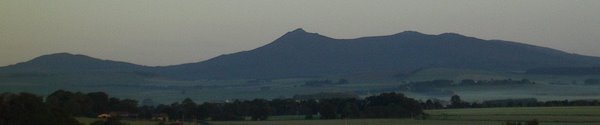
Barra hill viewed from the golf course.

Monday, October 6, 2008

Stoned in Meldrum


Now that things are back to normal, I would like to look at some of the current places around Meldrum, which have connections with the battle, legendary or otherwise.
I have already looked at Bruce’s Field, Comym’s Camp, Bourtie Kirkyard, and would now like to look at three of the most common objects to be found around the locality, namely big stones.
There are three specific stones in the vicinity with associations to the battle, and I would like to deal with them in the following order, The Grenago Stane, Wallace’s Putting Stone, and Bruce’s Seat.
But firstly I would like to speculate on why such common objects are often associated with important events. Has this to do with our ancient past? The North East is rich in stone circles, and other prehistoric sites, or is this need to associate events to the stones part of some long lost folk memory? Is it that a particular stone had significance to a particular age, and when that time passed, the stone or place of significance was transferred to the beliefs or legends of the current age? In the way it is said that pagan sites were often adopted by the early Christian church.
Any thoughts?
Next post “The Grenago Stane

Wednesday, September 24, 2008

After Ike


Just a quick post to say, that we are all OK here in Tomball Texas, following the passage of hurricane Ike.
Ike arrived in the area in the early hours of the morning of Saturday 13th , and we were very fortunate that the only damage to our property were a couple of fences down and countless branches, some of them large blown down. Some in our area were less fortunate and had trees fall on their houses. But all of us here were far more fortunate than the people in Galveston and other areas on or near the coast.

We finally had electricity restored last night, so Juliet and I are so relieved.
I am finally back on line so thought I would post an update and let everyone know that,


“Normal service will be resumed shortly”

Friday, September 5, 2008

The Moving of Sir Thomas

When I started this topic I had no idea that there would be so much material on Sir Thomas, but for now I think this will be the final chapter, but one can never tell.........
The Rev. Bisset, in the 1845 Statistical accounts, has this to say about the legend of Sir Thomas and Barra
This derives some vraisemblance from two rather rude images of a knight in armour and his dame, which occupied a niche in the old church of Bourtie. They lie now in the church-yard, neglected like the stranded remains of Polydorus. It is hardly necessary to remark, that no such knight as Sir Thomas de Longueville is known historically to have been amongst the followers of either party.
(I believe that the Polydorus referred to was the son of Praim (King of Troy), who was murdered by Polymestor, and his body left to rot. See Wikipedia entry on the subject for more details.
http://en.wikipedia.org/wiki/Polymestor)


Bourtie Kirk yard

Ninety years later a young Doug Smith was part of a team who moved the “stranded remains”, from the kirk yard to their present position inside the kirk.

Below is Doug’s account of the move:

"The effigies were moved from the churchyard to inside Bourtie Kirk in 1956. Tom Webster was the contractor. He also completed the Meldrum Kirk restoration in 1954. Willie Henry, foreman mason, was in charge. Kenneth Macmillan was the minister of both Bourtie & Meldrum kirks.
The effigies lay side-by-side close by the right of the path, approximately mid way between the entrance gate and the kirk doors. (I am certain they lay facing the kirk and due east)
There was significant weathering of the effigies which was the reason for moving them inside. Controversy and much debate took place about the move.
This job was far removed from the usual run -of -the mill work we did and proved challenging and interesting, not forgetting heavy.
No mechanical lifting aids were available. We used pick-axe handles to move them ( 6 of us in pairs) through the narrow doors with a tight turn into a small room, upended them and fixed them to the wall. Now they were facing west."


Doug with the figures he moved half a century ago

Doug also confirmed that they had to carry-out some repairs to the figures as well as securing them to the wall.

Further insight into the move comes from the “Random Memories”, of the late Rev Kenneth MacMillan, who was also provost of Oldmeldrum from 1956 -1957 and was the driving force behind the restoration of Meldrum Parish Church.

Rev Kenneth Macmillan wearing his Provost chain of office

In 1950/1951 Mr. Mackenzie of Bourtie House made a strong attempt to have the effigies placed in the body of the church. Mr. Mackenzie, who was a member of the firm of A. Marshall Mackenzie, well known Aberdeen Architects, drew up the plan with the effigies lying side by side on a plinth. This would have dominated the interior of the little Kirk, and found little favour with the congregation. At the meeting of the congregation held to decide whether to agree to the plan or not there was much discussion, then one of the elders (Proctor) killed the idea by saying, “We have enough sleeping members in the kirk without having more!”
The effigies remained outside until 1956 when a small section of the vestibule was turned into a museum and with the help of Tom Webster, the Old Meldrum builder, Sir Thomas and his Lady were set standing side by side on one of the walls. The church bell, which had fallen down and cracked, nearly killing the beadle as it fell, found a place in the museum. Also a pedestal font, found by workmen clearing the ditches near the church and three long handled offeratory ladles, one dated 1690 were among the treasures.
In a short time there were many less “sleeping members” and many more awake to the fact that the Bourtie Kirk was still the Parish church and that Bourtie was still a parish. It would be hard to forget names like Stronach of Selbiehill, Green of Collyhill, Manson of Smithycroft, Cooper of Shadowside, Morris of Greenford, and Miss Thompson who ran the Sunday School. They were all Bourtie folk with a sense of belonging.


Once again I have Evelyn to thank for providing a copy of the notes shown above, which are in the possession of the MBHS. A longer version of the notes also appears in Marion Youngblood’s book “Boutie Kirk - 800 Years” , which is well worth a read for anyone with a deeper interest in history of the kirk.
For those interested in the modern day church, information can be found on the following site:

https://www.meldrumandbourtiechurch.com/

Legion Update


Once again due to the hard work of Evelyn, we have some answers on the “Meldrum Sports” picture.

Past secretary of the Sports committee, Bob Forsyth, found the answers following a search of his collection of old “Sports” programmes.
The year was 1954 and the Sports that year were opened by The Marquis of Aberdeen


In 1954 the Oldmeldrum Branch of the British Legion presented an ambitious re-enactment at Meldrum Sports entitled:

'A Pageant in Four Scenes'


We now also know that Sir Thomas de Longville was played by George Meldrum, who at one time had a shop in the Square - in 1954 it was Gall and Bruce's shop.

The Pageant must have been some undertaking; the programme has pages of historical notes, too many to reproduce here. But this must have been the norm for the time because the following year they presented an equally ambitious re-enactment about the Raising of the Gordons. 12,000 attended that year & Richard Dimbleby opened the Sports.

Thanks Evelyn and Bob for all your efforts.