Monday, July 20, 2009

Of Comrades and Bon Accord

One of the problems with the Battle of Barra is knowing who participated. Everyone loves a winner so we have no shortage of candidates who “assisted” the King, and a dearth of those who supported the Earl.
So who were the “lesser” men who participated?
I have come up with some possible participants on the Royal side, but none for the Earl of Buchan. (No surprises there then!!)


Names which in later years would be synonymous with the north east, Keith and Gordon, are often credited with receiving their lands for service at Barra, but in May 1308 they still served the “dark side”. (That is not to minimise their later service to the King, – Keith would be one of the heroes of Bannockburn).
One who received NE lands in the 1320s was William de Irwyn (Drum), who is said to have joined Robert in 1306, and served him throughout the war, becoming his armour bearer and later secretary. Although there is no direct evidence of his presence it is reasonable to assume that as the King’s armour bearer he would have been at Robert’s side at Barra, and if the tales of him requiring to be held upright in the saddle by two men were true, one would surely have been William.


Another likely candidate is Gilbert de la Hay of Erroll, later to be High Constable of Scotland. Gilbert is said to have been with Robert from the start and was amongst those who came north with him in 1307.
An interesting tale is retold by the Rev. John Davidson, in his 1878 Inverurie and the Earldom of the Garioch, of an Inverurie farmer named Benzie, (I’m sure he meant Benvie – see everyone loves the winner!!!!!!) who with his eleven sons assisted Robert at Barra. He concedes that the tale is very similar to the founding legend of the Hays.
That legend tells of the battle of Luncary in the year 980, when Kenneth III, was battling a Danish invading force and his army fled, until confronted by a father and his two sons carrying plough shears. They taunted the fleeing Scots with their cowardice, compelling them to return to the fight, assisted by their three plough wielding countrymen. With the Danes defeated and the kingdom saved from invasion, the father is said to have sat down exhausted and wounded, crying out Hay! Hay!, which became the family name. Needless to say this tale probably contains little truth, because like many of the Scottish aristocracy the Hays were Norman, and did not arrive in England till 1066, so could not have assisted Kenneth. The tale may incorporate, and embellish, the family history of an older Celtic line that was assimilated through marriage. The Hay arms are three red escutcheons (shields) on white, which are said to represent the father and two sons.


Malcolm Earl of Lennox, is also reported to have travelled north with the king, and is another possible participant.

The Rev. Davidson also mentions a document as follows:
“ It is a formal declaration by an antiquarian of credit, that he had perused documentary evidence of the facts connected with the Fergusons of Inverurie, now a widespread family. One writing bore that Walter Fergus of Crichie received hospitably in his own home the great avenger of his country, King Robert Bruce; and with his three sons and dependants, in the memorable battle of Inverurie, in the year 1308, afforded ready and manly aid, on account of which distinguished assistance King Robert gave him ample possessions of the adjacent lands of Inverurie”
I have found no other reference to the above.


One of the outcomes of the victory at Barra was the capture of Aberdeen, probably sometime in July/August 1308.
Local folklore has the citizens of Aberdeen rushing to the aid of their king and assisting in the defeat of the Earl of Buchan. Another tale has them storming the castle and killing the English garrison. It is said that the origin of the city's motto," Bon Accord" was that it was the watch-word for the citizens engaged in the taking of the castle.
However there is no historical evidence for these stories, which may have been a way to explain Robert's endowment of the "freedom lands"* to the city, in the 1319.

I believe that the endowment was given for the many services the city performed after it's liberation by the royal forces. (There will be more about Aberdeen’s contribution to the war in a later post).


So in the final analysis we can only be sure of the main protagonists, the Bruce brothers on one side and Comyn, Moubray, and Brechin, on the other. It is highly unlikely that the citizens of Aberdeen participated, but there is a good probability that William de Irwyn and Gilbert de la Hay were with their King.
As for the others?; well my money is on James de Benvie leading the final charge. :)


* The freedom lands of Stocket were given to the city in 1319 and were the foundation of the present day "common good fund".
For information on the Freedom Lands see:


http://canmore.rcahms.gov.uk/en/site/19326/details/aberdeen+the+freedom+lands+boundary+markers/

Further details of the freedom lands,  see Aberdeen city council web site.

https://www.aberdeencity.gov.uk/services/planning-and-building/freedom-lands-and-marches#1579

NOTE: The battle of Inverurie mentioned above is the same as the battle of Barra.

.

Tuesday, July 7, 2009

Twitter

I am just inserting a nonsense post as a bit of fun, especially for those of you who “twitter”. Twitter is a micro-blogging site where you provide updates, but they are limited to 140 characters. http://twitter.com/ (You can find me there @ ChauvinOn)

I am researching a post on the Comyns, and I came across this paragraph in Fordun. *
The murder of John Comyn was covered in earlier posts, so I will not belabour the details.
--------------
“The same year, after the aforesaid Robert had left the king of England and returned home, no less miraculously than by God’s grace, a day is appointed for him and the aforesaid John to meet together at Dumfries ; and both sides repair to the above-named place. John Comyn is twitted with his treachery and belied troth. The lie is at once given. The evil-speaker is stabbed, and wounded unto death, in the church of the Friars; and the wounded man is, by the friars, laid behind the altar. On being asked by those around whether he could live, straight- way his answer is : — " I can." His foes, hearing this, give him another wound ; — and thus was he taken away from this world on the 10th of February"
---------------
It is interesting how the use of a word can change.
The word is derived from Old English “atwiten” to reproach.
* John of Fordun was a 14th century Scottish chronicler who died around 1384. His work was very supportive of the twin heroes Bruce and Wallace, at the expense of the "villains" Balliol and the Comyns
.

Friday, July 3, 2009

Bruce’s Seat


Well I have been very lax in posting, and this post is at least 6 months overdue. I am only going to touch briefly on Bruce’s Seat, because its history and its move to its current location have been covered in several earlier posts.

When I visited Oldmeldrum last year I had the pleasure of meeting John Pirie, a driving force behind the memorial, who was able to tell me some history of Bruce’s Seat. Unlike today, the earlier footpath between Oldmeldrum, and Boutie, went around the eastern slope of Barra hill and the stone was located just off this path. John said he remembered it from childhood, and when in the 50’s the area was ploughed-up, the large stones were removed and placed in heaps, he marked the spot of this special stone. Half a century later he was able to identify it and help with its recovery and relocation as the centre piece of the battle of Barra memorial. ( John described the location of the stone as follows: Going up past Red House to the hill and straight on it was about 300m on just over the first fence dead ahead.)


The eastern slop of Barra hill viewed from the golf course.
Red House is in the centre.

Heaps of stones dot Barra hill as evidence of the 1950's agricultural changes. These are viewed from the present footpath looking westward. Bruce's seat was in a similar heap but to the east.

The start of the present day footpath located behind "Blankets"

Thanks to John for all his assistance.

Well that’s it for this one; I hope the next post is not so delayed.

Saturday, October 25, 2008

The Grenago Stane 2


I have just received the OK to use the material from Rev. Haddow’s work, “Dowsing for Patterns of the Past – The stone Circles of Aberdeenshire”.

The following is the entry for the Grenago stane, for the full work go to: NOTE: The link was removed because the site was no longer available (May 2018) 

Quote.

This solitary stone stands in the middle of a golf course (Old Meldrum) and has no recorded associations with a stone circle.
“Grenago” means “groaning” and gets its name from the despairing cries heard from the Earl of Buchan at the stone when he fled from the Battle of Barra in 1308, his men being routed by King Robert the Bruce.

Fig. 37 shows the dowsing pattern pointing to a comparatively small recumbent stone circle of 7 stones including the recumbent. The variation of the rod`s response to the longest stone indicates a recumbent and its flankers close together; this was confirmed by the segment of energy between it and the centre of the circle where there is an elliptical shape measuring 10 feet 2 inches east-west by 8 feet 6 inches north-south.
The stone on the east of the circle was very close to the central area, i.e. 2 feet.
It is unusual for the recumbent and its flankers to be in the north-east.
These previous examples of standing stones show them, according to the dowsing pattern, to be part of stone circles and the position of the other stones could be found. As many stone circles have disappeared completely but their sities have been recorded, it should be possible by dowsing these areas to gain information regarding the type of circles which were there.


End Quote

Monday, October 20, 2008

Wallace’s Putting Stone

Our next geological star is known as Wallace’s Putting stone, and is located within the hill fort on the summit of Barra hill. (NJ 8024 2570). It is an example of a glacial erratic, and is described variously as a green or serpentine rock. It is also the largest of our trio with a girth of 24 feet. Quite how it acquired the name is unclear, because to my knowledge William Wallace has no particular connection with the area, but as will be seen he is incorporated into the mythology of the battle. It is one of three stones of the same name, the other two being located in the borders one near Galashiels, and the other on Raeberry Hill in Dumfries and Galloway.


There is a local folktale about Jock o’ Bennachie, a giant who guarded Bennachie.
Jock by all accounts was massive even for a giant but had numerous enemies, the main one being Jock o’ Noth. The two were said to have “traded compliments, in the shape of large bolders” which they hurled at each other. Wallace’s putting stone being one such bolder which went astray.
In one ballad Jock’s love, the Lady Anne, left him for Jock o’ Noth, and in his grief, Jock throws a boulder as the lovers stood on Tap o’ Noth, killing them both.
In the second Jock encounters a mystical woman whom he mistakes for the Lady Anne, and when he kisses her they both sink into the mountain and are never seen again. However legend has it that Jock is only asleep and when an enchanted key is found he will awaken and be free.
This legend is interesting because it was said that Bruce’s followers, during the period of his NE campaign, were spreading tales of a prophesy of Merlin.
One element of Arthurian legend is that Arthur is not dead, but sleeping, and will arise at the time of greatest need and lead the Celtic peoples to victory.


Bennachie

The Rev. Bisset, give the following account of the local legend of William Wallace and the Battle of Barra.

……..Jist at this time, whan a stir began amo’ them, (Comyn’s troops), Sir William Wallace, as wus agree’t on wi the Bruce, up’s wi’ a stane like a house-side, and wi the strength o’ 10 Galiahs, bungs’t frae the tap o’ Bennachie; and that they micht ken fa the compliment cam’ fra, he first prented the initials o his name (W.W.) i’ the side o’t. Fung it gaed thro’ the air and lichtin’ i’ the middle o’ the camp kill’t not a few, and gart the yird stot to the very clouds. The hurly wus noo complete, and oot o’er ither’s heeds like as mony sheep oot o’ a fauld………

And that is how the stone came to lie on the top of Barra hill in the middle of Comyn’s camp

Pictures courtesy of Moira Gregg

Tuesday, October 14, 2008

The Grenago Stane


The Grenago Stane, or Groaning Stone”, is located on the 14th fairway of the present day Oldmeldrum golf course. 
http://www.oldmeldrumgolf.co.uk/the-groaner-2/
For a more detailed location follow this link. http://www.geograph.org.uk/photo/898972


Legend has it that the Earl of Buchan lay beside the stone crying and groaning after his defeat by King Robert.

The stone long predates the battle of Barra, and according to the Reverend Angus H. Haddow B.Sc, in his work, “Dowsing for Patterns of the Past – The stone Circles of Aberdeenshire”, the stone once formed part of a long lost stone circle.
I had hoped to get permission to use some of the material, but have been unable to contact, the Rev. Haddow, so I am proceeding without it.

The stone features in an 1870 poem by the Oldmeldrum poet, James Fraser.

The Grenago Stane

Oh wha hasna heard o’ the Grenago Stane
That stands on the richt o’ the road to Kilblean
Like A sentry, on guard east end o’ the common
The object o’ interest to man and to woman.
When a cowherd, lang, syne, my leifie lane,
I’ve mused on the past by the Grenago Stane
An’ the spirit o’ history from sleep did me summon
To see Earl Buchan the notorious Comyn
When routed by Bruce below Hill o’ Barra,
He fled from the field wi’ the speed o’ an arrow,
Wi’ Fire and wi’ sword is driven fae Bara,
Tae pillow his head on the Grenago Stane,
His broadsword is dimmed o’ its glancing sheen,
The presence o’ Bruce on the field o’battle
Scattered his foes like a herd o’ cattle,
While the Earl ske-daddled to the Grenago Stane,
Sick at seeing where the conflict had been.
Thanks to the burghers o’ brave Bon-Accord
They cam wi’ what strength the town could afford,
And that help, that lives yet in memory green
Laid Comyn to groan by the Grenago Stane.
The Earl while resting was heard to groan
Hence, says tradition, the name of the Stone.
And deny who list
That the Earl had been lodger by the Grenago Stane.
Five centuries and mair have passed away
Since our brave fighting fathers did sleep in the clay,
But wha disna gaze wi ‘sparklin’ e’en
To where Comyn lay doon by the Grenago Stane?
Proudly did the Royal Flags float o’er the field
When the rebel invaders were driven to yield,
So perish all rebels to the reign of our Queen
And bury their bones by the Grenago Stane.

Can anyone provide information on James Fraser?

The stone is also mentioned in a foot note by Fred R. Coles, in his 1902, “Report on stone circles of North Eastern Scotland” for the Proceedings of the Society of Antiquaries of Scotland.
“Before quitting this district, I may note, in passing, the big boulder that goes by the name of Girnigoe, or Grenago Stone. It is, I think, an ice-poised boulder of whinstone, nearly 6 feet high, and roughly rhomboidal in contour, and stands on the commonty of Old Meldrum. In local histories it has a traditional association with a battle between Bruce and the Comyns.”


In modern times the stone apparently still retains the power to make grown men “groan”.
The Oldmeldrum Golf Club website carries the following warning:
“Look out on the 14th fairway for the Groaner or Groaning Stone, a large projection of ancient rock which inspired the club logo. If struck by a wayward shot, it can cost strokes by deflecting a speeding ball straight into oblivion”


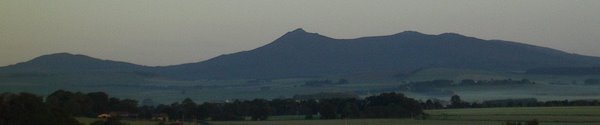
Barra hill viewed from the golf course.

Monday, October 6, 2008

Stoned in Meldrum


Now that things are back to normal, I would like to look at some of the current places around Meldrum, which have connections with the battle, legendary or otherwise.
I have already looked at Bruce’s Field, Comym’s Camp, Bourtie Kirkyard, and would now like to look at three of the most common objects to be found around the locality, namely big stones.
There are three specific stones in the vicinity with associations to the battle, and I would like to deal with them in the following order, The Grenago Stane, Wallace’s Putting Stone, and Bruce’s Seat.
But firstly I would like to speculate on why such common objects are often associated with important events. Has this to do with our ancient past? The North East is rich in stone circles, and other prehistoric sites, or is this need to associate events to the stones part of some long lost folk memory? Is it that a particular stone had significance to a particular age, and when that time passed, the stone or place of significance was transferred to the beliefs or legends of the current age? In the way it is said that pagan sites were often adopted by the early Christian church.
Any thoughts?
Next post “The Grenago Stane